Showing posts with label pompeii. Show all posts

Sunday, May 31, 2015

Day 11 - Pompeian Circumstance


A new record for me today, with over 835 photos taken at Pompeii and environs! Got out of my plain little room on the noisy boulevard around 8:30 am, stashed my bag at the train station, and went in to the Scavi (Ruins) of the town of Pompeii on a beautiful morning with clear skies and moderate temps, although I did shed my jacket before too long, unlike the day before at Stabia, where I kept it on all day. As I walked in I could hear the chants of the politically inclined out in the street, as they last minute campaigned for their champion down to the wire.


Juice stall with Sorrento lemons just outside the Pompeii gates


When I first came here with my family in 2007, there were very few things that were closed- essentially the Casa Vettii was the only one, and certainly no streets. The next time i was here was two years ago, and I felt extremely frustrated and hindered by the number of closures around town.  It was the same thing this time, with numerous streets and buildings inaccessible, but at least I knew what was coming. They have actually opened up a few more of them since the last time I was here, and everything looks like they're doing some good work. There's still a LOT of areas that are inaccessible, but at least they're doing something to preserve what's there. 


"Menu" of erotic options at the Suburban Baths. 

I decided to beeline for the Villa of the Mysteries before the big tour groups could get there, though I did stop off first at the Suburban Baths, which is right next to the entry ramp. They call them "suburban" because they were below the town walls, not out in the 'burbs. They feature some rather notorious sexual position murals that are thought to be a menu of possibilities for customers. "I'd like a number 7 please, with a little #4 for dessert." There's also a large cascading fountain and bath in the back that must have been quite something. After that I hiked over to the Villa, which is also outside the walls on the northwest side of town, and I was pleased to see that the crowd there was slim- just some French school kids in a bunch, and a few other people. I immediately went to the oecus- a big ocean-view social room- that has the famous mural of the mysterious rite for which the villa is named. I had plenty of time and space to attempt to get some good shots of it in the low light they keep it in for protection. Took twenty-five, only to then realize that my camera dial was set to "soft focus" accidentally! Urrrrghh! Why do they even include a setting like that? I was having a bit of camera envy for the big SLR rigs that some people had brought, since they let in so much more light than my pocket Nikon, but I love how portable mine is, and it actually takes pretty good photos and has a vey long zoom lens, so I'll stick with it.

Border detail from the Villa of the Mysteries. Precision work!

Slowly wandered through the rest of the house after that, marveling at the incredibly fine work in several of the rooms. Impossibly delicate decorations in so many different styles; the variety of pattern and structure has really struck me on this trip. Even simple patterns have variations in them that keep the eye coming back, and structural elements are subtly changed from one panel to another, so that what looks like a regular repeat is actually a whole compendium of forms placed in serial format, meaning that eye has more to see over time. The effect might sometimes look like stencil, but it is a very different feeling with much more satisfying visual pleasure. They must have had scores of painters for places like this, because no matter how good you are, and how long you've been doing it, work like that takes a lot of time! Some things about the painting are becoming apparent to me on this trip- technical details about fresco that I won't bore you with, though they're very interesting to me. After the house I became an informal tour guide to a couple of Americans I met there, guiding them to the Forum baths and a couple other painted spots with commentary. They both said I should hire out as a guide, which I've heard more than once here, but I need to save it for blogging. 

Picture of Narcissus from the House of the Ara Maxima, one of the ones that was closed last time. He is depicted in a pinake- an antique type of folding frame- sort of a picture in picture


Broke away from them by going at my usual snail-like photography pace and found a few of the spots that were closed last time I was here - that was fun - but I was pretty shocked at how many large chunks of the town are still totally inaccessible. Snacked on some peanuts ("arachidi" in Italian -we call them "arachnids") and the cherries I bought from the farm stand in Stabia, then made my way towards the exit, pausing to contemplate that I don't know when I'll be back, maybe not until I know they've reopened significant areas. 

The Stabian Baths are amazing. The tourists, not so much!


On my way to Herculaneum, my next stop, I was accompanied on the train by a boisterous bunch of high school age kids who yelling, slapping, grabbing, fighting, and generally creating mayhem in a way that only Italian kids can do, especially the ones from Naples area. Absolute chaos, but harmless. Got off in Herculaneum and casually strolled down the main drag towards the hotel, glad to have visited here once before to get the general layout. I made the one turn on the route, and noticed how much funkier the neighborhood gets as soon as you get away from the center. Not scary, but definitely rougher looking. Found the rather anonymous looking place, rang the bell, and waited several minutes before a woman answered and told me to come in and up to the first floor, which is what we call the second floor. She greeted me warmly and brought me in, but after a few minutes it appeared that they hadn't received any kind of notice from the online reservation company, Venere.com. She told me they were totally sold out, it being the big national holiday time, but her husband came down and said they had a rental apartment across the street that I could stay in. He walked me over and I looked at it, then we went back to the hotel part because there isn't any wi-fi at the apartment and I wanted to check emails and Facebook. They said I could hang out on the terrace there as long as I wanted, and it was very nice, with a great view of Capri and the Bay. I sat there quite a while, met an young English couple that had just arrived and were visiting the area for the first time, drank my soda water and watched the sun go down. I was going to go out and get something at a market, but it got late so I just skipped it. Maybe I'll lose a few pounds on the trip, which I could use.
View of the coast near Sorrento, from the terrace of the hotel I was supposed to have a room in.

Sunday, August 17, 2014

Pic o' the Day #1327- Thanks for Dancing!

Big thanks to those who joined us last night at the Grand Annex in San Pedro to celebrate the power of music!! Even if you only danced in your seats!


Opus sectile panel with Dionysiac dancers from the House of the Colored Capitals in Pompeii

Friday, August 15, 2014

Pic o' the Day #1326- Pin the tail on the What?

All we know about Roman era painting (Greek too, for that matter,) comes to us in the form of wall paintings. None of the panel paintings have survived the perils of time, with the exception of the funerary portraits that were locked away in the tombs of Egypt. But in a second hand way, we know that they existed, partly by verbal descriptions from Vitruvius and Pliny, and also by their depictions in several murals, such as this image from the House of the Ara Maxima in Pompeii.

If you look closely at the painting of Narcissus looking at his reflection in the water, you can see that both sides are flanked by folded shutters, which is how these paintings were protected (it also made them easy to display on a flat surface!) They are known as pinakes, and it's where we get the word Pinacoteca, meaning art gallery, which you will see in many places in Italy. Too bad none of the real things has survived!

Genre painting of Narcissus is given a trompe l'oeil shuttered frame. From the House of the Ara Maxima, Pompeii.

Wednesday, August 6, 2014

Pic o' the day #1319- Don't believe the Hype!

After reading in many guidebooks that the modern town of Pompeii was to be avoided, we were pleasantly surprised by it's large park like piazza, active passeggiata, and beautiful 19th century Marian church. Say what you will about 19th century ornament; they had worked it out to a science, which in the right hands could be masterful.
View of the main dome in the Beata Vergine del Rosario, the main basilica in the town of Pompei

View of the apse, painted in the late 19th century

Detail of ornament

Spandrel ornament over an arched window

Monday, August 4, 2014

Pic o' the Day #1318- Sunday Style Supplement (a day late!)


As I said a few posts ago, I'm not going to go deep on the painting styles of Pompeii just yet, but here's a little teaser for when I do. The Fourth Style is sometimes known as the Baroque or Intricate period of Roman painting. As it was the last period of art before Vesuvius buried Pompeii (in 79 AD), it is found in many places in the Bay of Naples. Although the styles continued to evolve in other parts of the Roman Empire, by far the largest bulk of our knowledge comes from this area that was so well preserved under the tons of ashes left by the volcano. 
One of the easy ways to recognize work that was done in this late style is what are sometimes called "Embroidery" style borders: simple but precise one or two colored strips with repeating elements that are usually quite abstract. Here's a few examples from my trip last summer.


"Embroidery" border in the baths area of the Villa San Marco at Stabia

Another pattern from the same room
corner detail from the House of the Gilded Cupids in Pompeii

Wednesday, July 23, 2014

Pic o' the Day #1311- Quails' Eggs and Darts

One of the fun things about studying ornament is finding common threads and unusual variations on a theme. One that I noticed in Pompeii last summer was this Corinthian column in the Basilica, which bears an uncanny resemblance to the columns in the Temple of Vesta at Tivoli, and is the only other place that I have seen this type of capital (other than modern variations). It's the ruffled and curled over vertical edges of the acanthus leaves that makes them distinctive; most other acanthus leaves have more prominent tops, while the sides are relatively flat. Here's a few images to illustrate what I'm talking about.


Corinthian capital in the Basilica at Pompeii. Notice the curly edges of the acanthus leaves.
A reconstructive drawing of the capital from Francois Mazois' Les Ruines de Pompeii, (1820).

Capital at the Temple of Vesta at Tivoli also has the ruffled edges of the acanthus leaves. It also has flutes that end  without being rounded

A more typical Roman style corinthian capital, as seen at the Pantheon. Here the tops of the acanthus leaves are the most pronounced part of the bell. 

The Ionic style capitals also have an interesting variant with "Quail egg" and dart, a style I have not seen elsewhere. This is also in the Basilica. 

Tuesday, July 22, 2014

Pic o' the Day #1310- The Lure of the Lares

In most houses in Pompeii you will find a shrine (sometimes two) that is usually called a "lararium", because it often held figures of the Lares, guardian deities that watched over the house and its inhabitants. There would also be statues of the prime deities (Juno and Jupiter, for example), ancestors, heroes, and small offerings to these various gods. Ceremonies of passage, thanks, and offerings would be held here, sometimes officiated by an outside priest (if you were wealthy enough.) These shrines persisted until the time of the Christians, when they were banned in favor of centralized places of worship (and fee collection!) 


Fairly elaborate lararium in the House of the Gilded Cupids

Shelves would have held figurines of gods, heroes, ancestors, and lares, along with offerings of food, flowers and monies.

Monday, July 21, 2014

Pic o' the Day #1309- Dog Day Afternoon


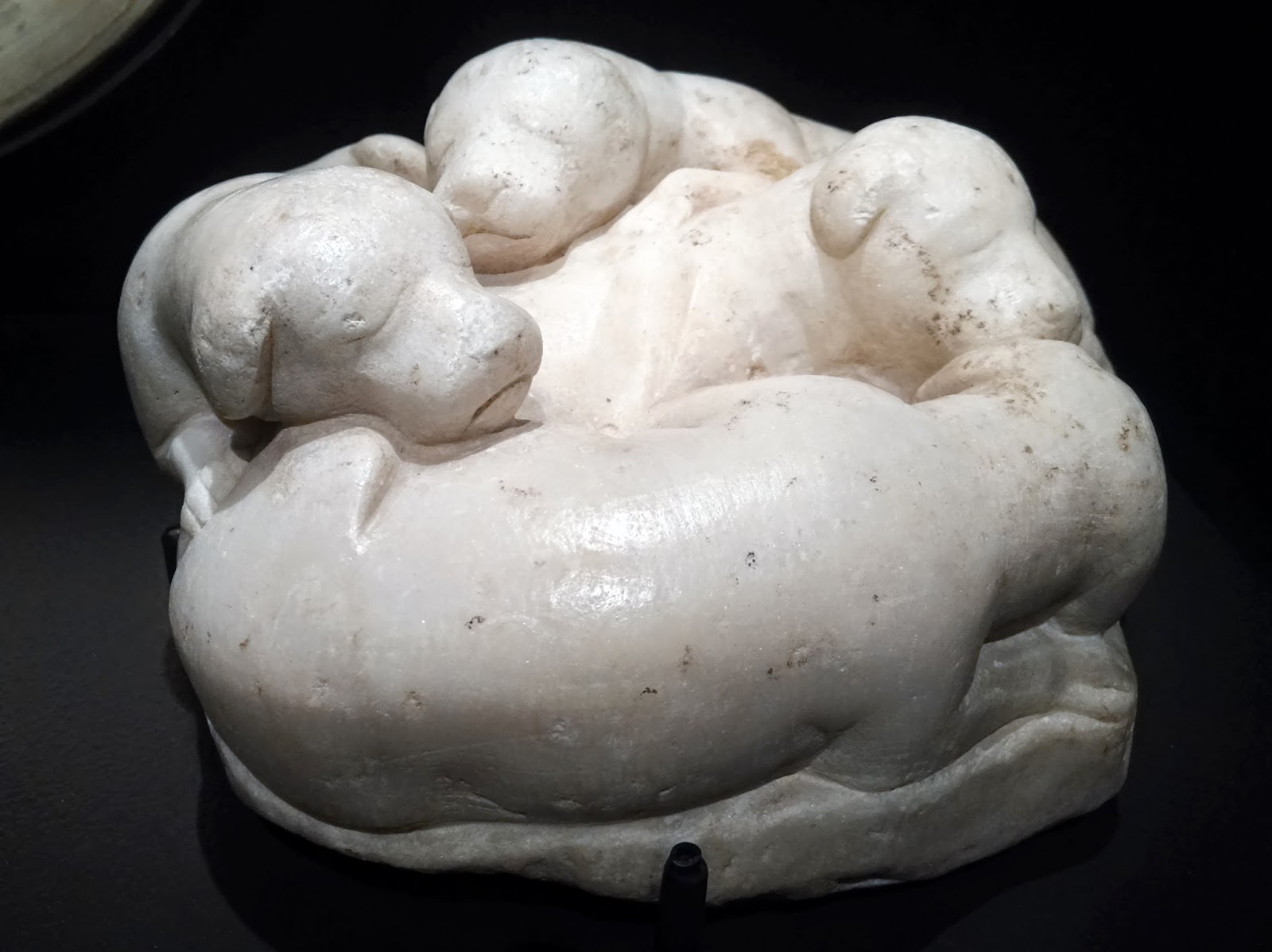
Spent the afternoon yesterday with some very good old friends looking at the Pompeii exhibit currently at the Los Angeles Science Museum. It was a bit thin in the display, and a bit long in the "interactivities" department, but there were still a few nice bits. This one was a little marble sculpture of puppies that was thought to have been in a garden area. Very cute!

Who can resist sleeping puppies?
There was also a large marble wash basin with elegant sphinx supports and an unusual triangular base.


Detail of the sphinx support. Love those wings!

Another detail of the vegetal ornament on the plinth. 


Saturday, July 19, 2014

Pic o' the Day #1308- Waddya gonna do?

The houses of Pompeii are in trouble! After exposure to the elements for 250 years, many of them are crumbling to dust, attacked by many factors such as rain water, invasive plants, vibrations from modern machinery, and the thousands of feet and hands that wander through and over them every day. 

One of the most vulnerable areas are the floors, which must bear the brunt of both water exposure that they were not designed for, as well as the weight of many more people than they ever experienced during their working lives. Solutions are not forthcoming quickly either (due to numerous factors) and thus many of these houses have simply shut the doors to prevent further damage until a trajectory, and the funding for that trajectory, can be found. Raised walkways, protective coverings, and regular maintenance are all possible, but they are all expenses too, and the sources for that funding are limited, especially when you consider the scale of the site. Did you know almost one third of Pompeii is still unexcavated, awaiting funds so that it can be preserved after it is exposed?

I spoke a bit about opus signinum a few days ago, and today I will talk about its big sister, mosaic. Besides the fancy pictorial or compartmented style of mosaics seen in the first photo here, the simpler random style of mosaic was very popular and is found in many of the houses in Pompeii. Like the opus signinum, it protected the floor and gave many years of wear (consider that some of these floors have now been walked on for over 300 years!), but it could be created by less skilled artists, and was thus less expensive. It was funny to notice how many of these random looking patterns resemble the inexpensive linoleum that covered the floor of my childhood kitchen floor, providing many of the same functions.


Floors of the House of Cuspius Pansa are spectacular, but you can't go in now for fear that they will crumble, as so many already have. 
Section of the floor of the Villa of the Mysteries, where you can see how many floors look there now. Fortunately, this one was being restored in 2013.


Patterning of this random style floor is found in many houses of the period. It looks so much like linoleum patterns I grew up with in houses of the 1950's.


Another all over pattern of the same type

Reverse pattern with color on a white background. Great way to use up your leftover marble chips!

Friday, July 18, 2014

Pic o' the Day #1307- Just like Grandma's

In a few of the antique houses in the Bay of Naples area (the shadow of Mt Vesuvius) you will find rooms like this one, with all over patterns that resemble wallpaper you might have seen earlier in the twentieth century. Only difference is they're not printed, or even stenciled, but instead are laboriously hand painted over the entire surface. Thus, unlike today, where repeat patterns are seen as common and cheap, this was a luxurious treatment worthy of a fine room in a fine home, which the House of the Gilded Cupids was. As you can see, it also had a mosaic floor, a faux marble socle (the lower part of the wall), and a vaulted ceiling with more plaster and painted decoration. 


Field pattern in the House of the Gilded Cupids looks like wallpaper, but it's not.

Wednesday, July 16, 2014

Pic o' the Day #1307- Snakes Alive!

In Roman times the snake was not seen as a symbol of evil but quite the opposite- of good fortune and longevity. Everywhere you look in Pompeii you will find decorations featuring snakes receiving offerings- in this case a pine cone and what looks like a fig, sitting on top of an altar. They are part of the decoration of a lararium, the small household (or even business- they are found in many of the town's restaurants) shrine where ancestry and family rites were celebrated. 


Tuesday, July 15, 2014

Pic o' the Day #1306- the Roots of Linoleum

Pompeii also has great floors, and that's one of the prime concerns in terms of conservation. Besides the laborious full mosaic patterns, there was also a technique called opus signinum that incorporated smaller bits of stone in a cementitious flooring material that was durable and shiny, but less costly than a mosaic. Many different patterns can be found around town, both indoors and out. Actually, it's more like terrazzo than linoleum, but the patterning is not unlike what you'd find today on peel and stick tiles at Home Depot.


In the House of the Gilded Cupids (Amorini Dorati)

Same house, different room.


Monday, July 14, 2014

Pic o' the day #1305- Wine and painting, a long tradition!

This post is simply about something that I thought was pretty cool when we were last in Pompeii. I've already ranted about how much of the painted walls were inaccessible, but this was a new development I enjoyed seeing. 

They've long been mapping out the placement and even the type of plants that were in Vesuvius' shadow, using the same technique they originated to record the positions of the bodies found in the ashes. They pour plaster into the voids left by organic matter to see the approximate shape of it, using it to produce castings of bodies,  wooden objects, and even the roots of plants like these grape vines (the upper parts would have been mostly burned away by the hot gases and ash.) Recently one of the projects has been to replant a number of the vineyards in the exact configuration of the originals, even using antique vine stocks and trellising techniques to get as close as possible to the way the Pompeiians grew. I'm certain that wines based on these original varieties can't be far behind. Wonder what they'll name it?

The style of trellising the grapes is partly based on fresco depictions of vineyards that appear in a number of Pompeiian houses.  
Even the varieties are researched through seeds and the shapes of the roots found.

This beautiful little peristyle garden is in the House of the Gilded Cupids (Amorini Dorati) and is also based on the root castings made from the plants that were there in 79AD

Thursday, July 10, 2014

Pic o' the Day #1303- Pompeii revisited

Those of you who were reading the blog last year (http://artworks2000.blogspot.com/2014/01/day-28-poopei-or-is-it-pompoop.html) as I was taking these shots know that I was pretty bitter the day we visited Pompeii, because of all the closures. I guess the lack of funding has finally reached a crisis point where they have just decided to lock up huge areas, including whole streets, from viewing.

Nevertheless there were some choice bits that were still on view, like this detail of a gryphon from the Stabian Baths. I'd be curious to hear from anyone who's going (or has already been) there this summer as to how it's looking and how much of it is closed.


Fresco of a gryphon in the Stabian Bath at Pompeii

Sunday, January 26, 2014

Day 31-Manly MAN.

(originally posted on facebook July 12, 2013)

Ok- this is it! We're only going to stay one more week. I promise. 

The MAN I'm referring to above is the Museo Archeologico di Napoli, where all the choicest bits of Pompeii, Herculaneum, Stabia, Boscoreale, Boscotrecase, and several other Roman era sites from the Bay of Naples ended up. Just like us. Seriously though, this is one major collection of antique art, including sculptures, mosaics, frescoes, and bits of architecture. I had to limit myself to the frescoes and mosaics or we would have been there a whole other day! As it was I took 600 photos, including a shot of every piece of fresco that was on display (a few weren't- just to make sure I come back next time. There's also a ton of architectural fragments I'd like to shoot some day.)
Entry to the MAN is in the traditional combination of red stucco and gray tufa stone ornament. You see this combo all over Napoli.

Our last minute train station hotel was actually rather nice (and cheap- 60 Euros- Thanks Rick Steves!) (I'm planning to do a wrap up report with all the travel details so I don't forget, and so others can use the info too.) Used the metro system to go up the hill and went up to the museum for the second time on this trip- the first time the fresco collection was closed and we left in a huff.
Don't know who he is, but I like his attitude!

We first went to the hall of mosaics, culled from many famous houses of the area- the House of the Faun in Pompeii has a whole room to itself. The fineness of these pieces is incredible! The Alexander the Great Battle scene, which was on the floor in the House of the Faun, is about 8 feet tall and maybe 16 feet across, and it's done with tiles that are no larger that 1/4 inch, if that! Some of the other large pieces verge on micro-mosaic technique. The coolest thing about mosaic is how the colors don't change over time, and they can be cleaned very well, so you get an "as new" impression except for where the tesserae are missing. It also informs ones view of how good the painting must have been then.

Mosaic from Pompeii

Tucked behind the mosaic collection is the infamous "Gabinetto Segreto" the (formerly) secret room full of erotic art that until the 1960s was only viewable by special appointment, and only to men- no women or children. The presence of phalli and other erotica is now open to all, and the meaning and mythology is pretty well explained by numerous placards in Italian and English. Good stuff!

"Is that really how you feel?"

Enough with the antipasti, it's time for the main course. Had a minor moment of panic when we went through the hall of objects to where I had gone in to the frescoes last time, only to find a barricade and people doing some kind of photo work behind it. Before I completely melted on the floor, a nice museum docent explained that the bulk of the frescos were open- just go in a different door! Whew!

Even the hallways in between the galleries are pretty spectacular!

I'm not sure whether it was better to have visited the sites first and finished up with dessert or to have had this in mind as we looked at all the more weathered bits; in any case it was a treat to see all these well preserved and well documented fragments in one place. Again the fineness of the work is astonishing- there are faces that look as if they were painted with a five-ought brush, and the range of treatments from highly ornamental to accomplished figurative and landscape painting, tragic to comic, shows a complete mastery of technique and rhetoric. 

Look at how finely painted this is- it only measures about 5 inches across!

I literally took at least one photo of every piece in the frescoes section- sometimes 5 or 6! Not only is it technically very interesting, it's also work that has been highly influential throughout the history of art until this century, when most artists seem to have deliberately forgotten it. You know what they say about forgetting history, don't you?


I love the frieze supported by figures motif. I hope to use it at the Villa Tramonto if it gets back on track.
After fine tooth combing that section we perused more leisurely through the hall with household objects. This is the other aspect of Pompeii and Vesuvius' other victims. There are so many pristine 2,000 year old objects here- it really shows the level of sophistication the Romans had gotten to. All kinds of kitchen utensils and tools, drawing instruments, ceramics and glassware of incredible variety, bathroom things, they even have a couple of specula for giving gynecological exams- they look remarkably like their modern counterparts. 

Bowls of powdered pigments found at Pompeii and Herculaneum, in some cases right next to the frescos that were being worked on.
Finished up there with a spin through the wing devoted to nothing but things gleaned from the Villa dei Papiri- the mansion on the edge of Herculaneum that was copied more or less for the Getty Villa in Los Angeles. Besides the trove of papyrus scrolls that it is named for (and which they think may soon be decipherable through modern technological means without unrolling) there is a huge assortment of sculptures both marble and bronze. 
There are several rooms that have nothing but items from the Villa di Papiri in Herculaneum. It must have been a veritable museum itself.
We've now made it back to Rome and have found a wonderful replacement for the Casa Stinky; a very nice apartment in Trastevere with a real kitchen, a washing machine, and a good internet connection. We're all set for one more week of adventures!


Friday, January 24, 2014

Day 30- Back'a Napoli

(originally posted to my facebook page July 11, 2013)

Headed to Herculaneum this morning after a quick stop at the sanctuary church in Pompeii, which is actually a very nice late 19th to early 20th century interior clad in mosaics, beautiful marbles, and painted murals. It's quite rich. Many guide books will steer you away from the modern town of Pompeii. I say they're nuts! Very pleasant place to stay in my opinion.

19th century interior of the Sanctuary Church of Pompeii

Herculaneum was easy to get to from the train, and as soon as we got in I knew I was going to like it. It was so much more relaxed than Pompeii, and it's like Stabia in that a lot of it has roofs and walls that have been completed to their original height. Because Herculaneum was covered in hot mud flows rather than the volcanic ash that hit Pompeii, it's roofs were left more intact, and wood beams (and furniture, and even some loaves of bread!) were carbonized but left in place, so you can see exactly what was there. 
Buildings on the left were facing the sea in Roman times. The wall at right is the depth of the mud and ash that covered over the town and entombed it for almost 1700 years!

There are a lot of good frescoes and mosaics, as well as gardens and other details. 3 or 4 of the best houses were having restoration work, but it was nowhere near as devastating as at Pompeii. You really get a sense of how the houses were perched on a ledge above the sea (as at Stabia) even though they are now facing a large wall of the mud deposits that covered them (the total thickness is something like 70 feet!) I would recommend this over Pompeii, at least until Pompeii reopens more of the site.

the Atrium of the House of the Wooden Screen gives an idea of  the size and enclosure of the preserved houses in Herculaneum. The house is named for the screen seen in the middle of the room as it was found- the wood is carbonized but intact, with bronze bosses still in place.

We had stashed our bags in a very friendly Tourist Info office up by the train station, and on our way back we checked email to find that our place in Rome would not be available for another day. We decided to spend a night in Naples so that we could visit the Archeological Museum early, then head back up to Rome. Got in and found a place pretty easily and then spent the next 3 hours dealing with the damn bank, who managed to screw up our accounts royally, despite all the prep work Marianne had done to avoid this before hand. Very frustrating, but I think she prevailed in the end.

Atlantes on a building in downtown Napoli. 


So we set out kind of later than expected to do a little exploring and find something to eat. 

Naples is purest anarchy. If you have never been here it's hard to describe. It's dirty to be sure, and danger is lurking around train stations and dark alleys (I got pick pocketed here on our last trip) yet it also has an allure and a spirit that is still going strong after 2500 years of continuous occupation. Most of the cliches of New York Italians come either from here or from Sicily. Waving hands while talking loudly, disrespect for authority, but also very public signs of affection- everything is happening in the streets in Naples. There's pretty good street food here too- even though I can't eat the pizza (wheat allergy), it sure smells good. I did eat fried zucchini flowers and rice balls (arancini) from a street stall, and they were great. The street bars near the Piazza Dante were overflowing with young faces drinking and chatting, and we both remarked how this is something America could really use. It's almost like the high school quad continued through life. You can check in with friends without the pressure of having to make some event- it's just there every night.  

Bustling street bars are all over Napoli- great town to visit,  just don't dangle your wealth in hands reach.


I think Naples has some kind of informal contest to see who can get the most people and objects onto a scooter. We saw young teens driving three at a time, couples with young kids wedged in between, or the kid in front standing and holding on the bars, dogs, five gallon paint buckets, and of course talking on the phone. While zipping down these narrow alleys that pass for streets. Two way streets! Got back to our hotel fine after getting a bit turned around near the station. You never want to pull out your map when you need it worst!